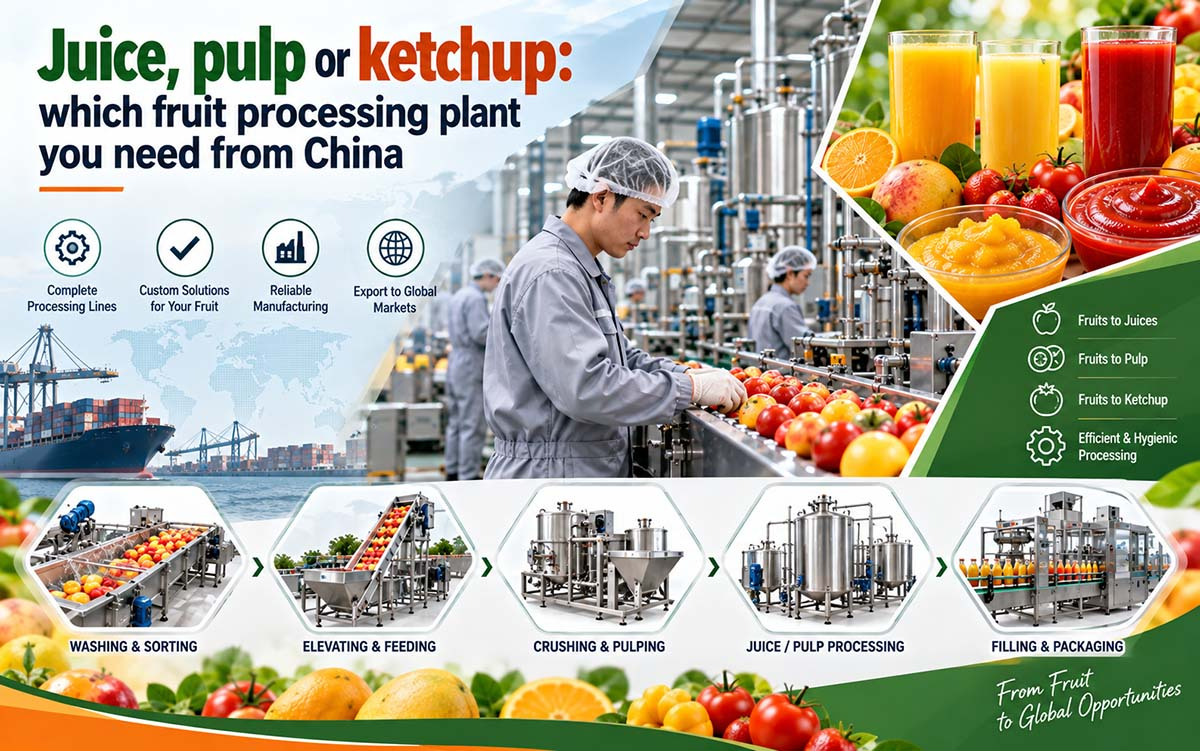
Buyers ask for a juice plant and describe four different factories. How pulp, juice and sauce plants differ, what fresh fruit versus concentrate does to your capital cost, and the systems that are missing from most first quotations.
Buyers come to us asking for a juice plant and describe four different factories. The word covers a machine that presses fruit, a line that fills bottles, and a plant that does everything in between — and the price difference between them is an order of magnitude.
Here is how the equipment actually divides, so you can tell a supplier which one you mean.
The three products, and why they are different plants
Pulp and puree is fruit reduced to a stable semi-finished good, usually in aseptic bags or drums, sold to other manufacturers. The plant is a pulp processing plant: wash, sort, pulp, refine, deaerate, pasteurise, fill aseptically. There is no bottling. Most mango, guava and tomato paste operations are this.
Juice for retail starts from fresh fruit or from purchased concentrate and ends in a sealed pack. A juice processing plant adds blending, standardisation, homogenising, final pasteurisation and a filling line. If you buy concentrate rather than fruit, the whole extraction half disappears and the plant is perhaps a third of the size.
Ketchup, sauce and paste is a cooking process, not an extraction one. A ketchup plant needs evaporation, a vacuum cooker, a mixing and dosing system for sugar, salt, vinegar and starch, and a filler that handles a high-viscosity product. A juice filler will not do it.
Fresh fruit or concentrate: the decision that sets your capital cost
If you process fresh fruit you carry the extraction line, the seasonal peak, and the fruit-handling labour. Your plant must be sized for the harvest, not the average — which means it stands underused for much of the year.
If you start from concentrate you buy a much smaller plant, run it all year, and accept a lower margin and a dependency on someone else's supply.
Neither is wrong. But a plant sized for one cannot be converted to the other cheaply, so it is worth being certain before the layout is drawn.
Where vegetable lines differ
A vegetable processing plant shares the washing and sorting front end and then diverges. Vegetables usually need blanching, which fruit lines do not have, and the finished product is more often frozen, canned or dried than bottled. If you are running both fruit and vegetables through one factory, the shared section is smaller than people expect — realistically the intake, wash and sort, and not much else.
The part nobody asks about until commissioning
Three systems decide whether a food plant passes an audit, and they are almost never in the first quotation:
- CIP — clean-in-place. Without it, cleaning a juice plant means dismantling it. With it, cleaning is a programmed cycle. Ask how many circuits, and whether the tank volumes are sized for your longest pipe run.
- Sterilisation — the thermal step that gives you shelf life. Tubular, plate or scraped-surface depends on viscosity and particulate size. A supplier who proposes plate for a pulp with fibre in it has not read your product description.
- Tanks, sanitary pumps and pipework — the plumbing between the machines. Cheap here means dead legs, poor drainage and surfaces you cannot clean, which is the fastest route to a failed inspection.
These are not optional extras. A plant quoted without them is not a complete plant, and the gap usually appears after the deposit is paid.
Filling: match the filler to the product and the pack
Hot fill, cold aseptic and ambient fill are different machines. A carton filler and a bottle filler are not interchangeable, and the pack format is usually a marketing decision made after the plant is ordered — which is the wrong way round.
Settle the pack first: format, size, material, closure, and whether you need batch and expiry coding on the line.
What to tell a supplier
- Which fruit or vegetable, and whether fresh or concentrate
- Tonnes of raw input per hour, and weeks per year of operation
- The finished product: pulp, juice, paste, or frozen
- The pack, exactly
- Whether you need CIP, and what your water and steam supply is
- Floor area, ceiling height and drainage
Answer those six and a serious supplier can draw you a line. Answer fewer and you will get a price for equipment that may not be the equipment you need.
We build fruit, vegetable and sauce plants to specification. Tell us what you are making and we will come back with a layout, a throughput figure and a price.